






Why Peterson Tuners Have Been Trusted Since 1948
Most players don't think much about tuning accuracy until they start playing with other musicians, recording in a studio, or setting intonation on a guitar that just won't sit right. Then it becomes obvious: not all tuners are created equal, and the difference between a $15 clip-on and a professional strobe tuner is not just price — it's a fundamentally different level of precision.
Peterson has been at the center of that precision for over 75 years. Here's why their tuners remain the standard for serious players, and what makes them worth the investment.
Peterson's Legacy Since 1948
Peterson's association with precision tuning dates back to 1948, when the company began developing strobe tuning technology for professional and institutional use. Long before digital tuners existed, Peterson strobe tuners were the tool of choice for piano technicians, orchestras, music schools, and recording studios that needed accuracy beyond what any mechanical tuner could deliver.
That legacy didn't fade when digital tuners arrived — it evolved. Peterson took the physics of strobe tuning and built it into compact, pedalboard-friendly, and clip-on formats without sacrificing the accuracy that made them famous. Today, Peterson tuners are used by touring guitarists, studio engineers, luthiers, guitar techs, music educators, and orchestral musicians worldwide.
What Makes Strobe Tuning Different
Most standard chromatic tuners work by detecting the dominant frequency of a note and displaying whether it's sharp or flat. They're fast, affordable, and good enough for casual playing. But they have a ceiling — most are accurate to about ±1 cent, and some are worse.
Strobe tuning works differently. A strobe tuner compares the incoming pitch against a precisely generated reference frequency and displays the difference as a moving pattern. When the pattern stops moving, the note is perfectly in tune. This method is inherently more accurate and more sensitive to small pitch deviations than standard chromatic detection.
Peterson's Virtual Strobe Technology™ replicates this behavior digitally, delivering the accuracy of a mechanical strobe tuner in a compact, durable format. The result is a tuner that doesn't just tell you whether you're in the ballpark — it shows you exactly where your pitch is landing in real time.
Why 0.1-Cent Accuracy Matters
All current Peterson tuners achieve accuracy to 0.1 cent — that's one-tenth of a cent, or one-thousandth of a semitone. To put that in perspective, most players can hear pitch differences of around 5–10 cents in a musical context. A standard chromatic tuner accurate to ±1 cent might leave you 2 cents off without flagging it. Over multiple strings and multiple instruments in an ensemble, those small errors compound.
For everyday strumming, ±1 cent is probably fine. But for recording, intonation setup, ensemble playing, or any situation where your instrument needs to lock in with others, 0.1-cent accuracy is the difference between sounding right and sounding slightly off in ways that are hard to identify but easy to hear.
It's also why guitar techs, luthiers, and studio engineers reach for Peterson tuners when precision matters most.
Sweetened Tunings™ Explained
Here's where Peterson tuners go beyond accuracy into something genuinely useful for real-world playing.
Standard equal temperament — the tuning system used by virtually all modern tuners — divides the octave into 12 mathematically equal semitones. It's a compromise that allows instruments to play in any key without retuning, but it means that certain intervals are slightly out of pure tune by design. On a guitar, this can mean that even a perfectly equal-tempered instrument sounds slightly off when playing chords, especially in certain positions on the neck.
Peterson Sweetened Tunings™ address this by applying subtle, instrument-specific pitch offsets to each string. Instead of tuning every string to a mathematically equal reference, Sweetened Tunings compensate for the acoustic characteristics of specific instruments so the result sounds more naturally in tune to the human ear — especially when playing chords.
Peterson tuners include dozens to over 130 Sweetened Tuning presets depending on the model, covering guitar, bass, acoustic instruments, ukulele, mandolin, banjo, pedal steel, lap steel, orchestral strings, wind instruments, and more. You select a preset, tune to it, and your instrument simply sounds better in a musical context.
Buzz Feiten Tuning System: One Example of Compensated Tuning
One well-known example of a compensated tuning system supported on Peterson tuners is the Buzz Feiten Tuning System. Developed by session guitarist and producer Buzz Feiten, this system applies specific nut compensation and per-string tuning offsets designed to improve the overall intonation of the guitar across the entire fretboard — not just at the open strings or 12th fret.
Guitars built with the Buzz Feiten system require tuning to specific offsets rather than standard equal temperament, and Peterson tuners include Buzz Feiten presets to make that process straightforward. If you own a Buzz Feiten-equipped guitar, a Peterson tuner is one of the most reliable ways to tune it correctly.
But Buzz Feiten is just one example. Peterson's Sweetened Tunings ecosystem covers a wide range of compensated and alternate tuning systems, historic temperaments, and instrument-specific presets. It's a toolkit, not a single feature.
Why This Matters for Certain Washburn Guitars
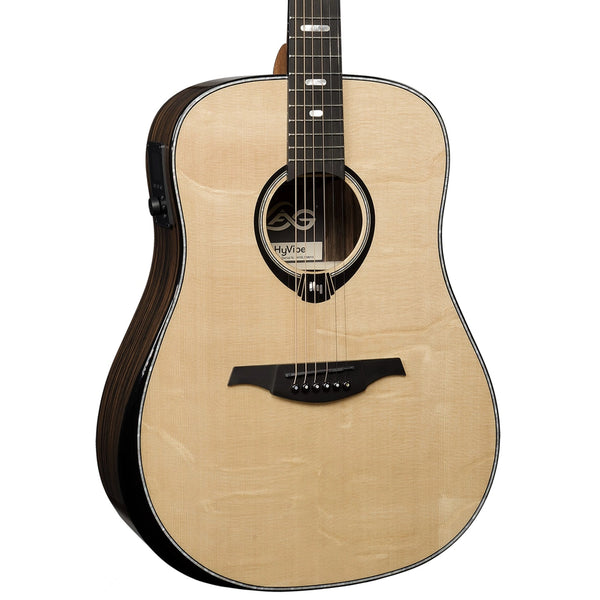
If you play a Washburn Wing Series guitar or another Washburn model equipped with the Buzz Feiten Tuning System, this is directly relevant to how you should be tuning your instrument.
Buzz Feiten-equipped guitars are built with specific nut compensation that shifts the optimal tuning offsets away from standard equal temperament. Tuning a Buzz Feiten guitar to a standard chromatic tuner — even a good one — can leave the instrument sounding slightly off across the fretboard, because the tuner doesn't know about the compensation built into the nut.
Peterson tuners with Buzz Feiten-compatible presets solve this cleanly. Select the appropriate preset, tune each string to the specified offset, and the guitar's built-in compensation works as intended. The result is better intonation across the full range of the neck, not just at the open strings.
For players who have invested in a quality instrument like a Washburn Wing Series guitar, pairing it with a Peterson StroboStomp HD or a Peterson StroboClip HDC is a straightforward way to make sure the instrument is always tuned the way it was designed to be heard.
Which Peterson Tuner Is Right for You?
Peterson makes tuners for different playing situations. Here's a quick guide:
Peterson StroboClip HDC — The best clip-on option for players who want rechargeable convenience. Built-in lithium-ion battery, USB-C charging, 10 selectable display colors, and over 65 Sweetened Tunings. Great for guitar, bass, ukulele, violin, mandolin, and wind instruments.
Peterson StroboClip HD — The non-rechargeable clip-on option powered by a CR2032 battery. Same Peterson strobe accuracy and over 50 Sweetened Tunings in a compact, affordable format.
Peterson StroboStomp Mini — A mini pedal tuner built for crowded pedalboards. Less than half the size of the StroboStomp HD, with top-mounted jacks, true bypass, buffered output, monitor mode, and over 80 Sweetened Tunings. Ideal for guitarists and bassists who want Peterson accuracy on the board without sacrificing space.
Peterson StroboStomp HD — The full-size professional pedal tuner with the largest display in the StroboStomp lineup. True bypass, buffered bypass, monitor mode, over 135 Sweetened Tunings, and a 9V DC output for powering another pedal. The go-to for players who want the most complete feature set on their board — and the recommended choice for Buzz Feiten-equipped guitars on a pedalboard.
Peterson StroboVUE HD — An always-on buffered tuning monitor designed for players who want continuous pitch visibility without interrupting their signal. Features a vibrant HD display with selectable colors and over 130 Sweetened Tunings. Note: the StroboVUE does not include true bypass.
Why Buy from ECG Music?
ECG Music is an authorized Peterson dealer and a real independent guitar shop. We carry Peterson tuners because we believe in them — and because we know firsthand how much difference a precision tuner makes, especially when you're playing a quality instrument like a Washburn Wing Series guitar built with the Buzz Feiten system.
If you have questions about which Peterson tuner works best with your instrument or your pedalboard setup, we're here to help. We inspect and support the gear we sell, and we ship nationwide.